Understanding Meridians: The Pathways of Acupuncture
Meridians are the energy pathways that acupuncture works with. Understanding them helps explain how points on your hand can affect your headache or digestion.
One of the questions I'm asked most often as an acupuncturist is: "How does putting a needle in my hand help with my headache?" It's a great question, and the answer lies in understanding meridians — the energy pathways that form the foundation of acupuncture.
If you've ever looked at an acupuncture chart, you've seen them — the lines running across the body with dots marking specific points. These lines are meridians, and understanding them is key to understanding how acupuncture works.
What Are Meridians?
In Traditional Chinese Medicine, meridians (also called channels) are the pathways through which Qi (vital energy) and blood flow throughout the body. They form a network that connects every part of your body — from your internal organs to your fingertips — into one integrated system.
Think of meridians like a river system. Just as rivers carry water and nutrients across a landscape, meridians carry Qi and blood throughout your body. And just as a blockage in a river affects everything downstream, a blockage in a meridian affects everything along that pathway.
The Twelve Primary Meridians
There are twelve primary meridians, each associated with a specific organ system and each running along a defined pathway on the body:
The Lung Meridian
- Pathway: Starts in the chest, runs down the inner arm, and ends at the thumb.
- Functions: Governs respiration, skin, and immunity. Associated with grief and letting go.
The Large Intestine Meridian
- Pathway: Starts at the index finger, runs up the outer arm, across the shoulder, and ends at the side of the nose.
- Functions: Governs elimination. Associated with releasing what no longer serves us.
The Stomach Meridian
- Pathway: Starts under the eye, runs down the face, chest, and abdomen, and ends at the second toe.
- Functions: Governs digestion and nourishment. Associated with worry and overthinking.
The Spleen Meridian
- Pathway: Starts at the big toe, runs up the inner leg and abdomen, and ends at the side of the chest.
- Functions: Governs digestion, blood production, and energy. Associated with worry and nurturing.
The Heart Meridian
- Pathway: Starts in the chest, runs down the inner arm, and ends at the little finger.
- Functions: Governs blood, blood vessels, and the mind (Shen). Associated with joy and anxiety.
The Small Intestine Meridian
- Pathway: Starts at the little finger, runs up the outer arm, and ends at the ear.
- Functions: Governs separation of pure from impure. Associated with clarity and discernment.
The Bladder Meridian
- Pathway: The longest meridian — starts at the inner eye, runs over the head, down the entire back (in two parallel lines), and ends at the little toe.
- Functions: Governs water metabolism and the nervous system. Associated with fear and willpower.
The Kidney Meridian
- Pathway: Starts at the sole of the foot, runs up the inner leg and abdomen, and ends at the collarbone.
- Functions: Governs the body's vital essence (Jing), growth, and reproduction. Associated with fear and wisdom.
The Pericardium (Heart Protector) Meridian
- Pathway: Starts in the chest, runs down the inner arm, and ends at the middle fingertip.
- Functions: Protects the Heart. Associated with relationships and emotional boundaries.
The Triple Burner (San Jiao) Meridian
- Pathway: Starts at the ring finger, runs up the outer arm, and ends at the outer eyebrow.
- Functions: Regulates the body's three "burners" (respiration, digestion, and elimination). Associated with metabolic balance.
The Gallbladder Meridian
- Pathway: Starts at the outer eye, zigzags across the side of the head and body, and ends at the fourth toe.
- Functions: Governs decision-making and the smooth flow of energy. Associated with anger and courage.
The Liver Meridian
- Pathway: Starts at the big toe, runs up the inner leg, and ends at the ribs.
- Functions: Governs the smooth flow of Qi and blood. Associated with anger and vision.
How Meridians Explain Acupuncture
Understanding meridians explains why acupuncture points can be far from the area of pain or dysfunction. A point on your hand (on the Large Intestine meridian) can affect your face and head because the meridian runs from your hand to your face. A point on your foot (on the Liver meridian) can affect your mood and digestion because the Liver meridian connects those areas.
This is also why acupuncturists often treat points on the arms and legs for problems in the head, torso, or internal organs — the meridians connect all these areas.
The Science Behind Meridians
While meridians were mapped thousands of years ago, modern research has begun to validate their existence:
- Connective tissue pathways: Research shows that acupuncture meridians often follow planes of connective tissue (fascia) in the body.
- Electrical properties: Acupuncture points have measurably lower electrical resistance than surrounding skin, and these points often fall along meridian pathways.
- Neuroanatomy: Many acupuncture points correspond to areas where nerves bundle or enter muscles.
- Radioactive tracing: Studies using radioactive tracers have shown that substances injected at acupuncture points travel along meridian-like pathways.
While we don't yet have a complete Western explanation for meridians, the evidence suggests they represent real physiological connections — perhaps involving fascia, nerves, and the body's bioelectric system.
How I Use Meridians in Treatment
When you come in for acupuncture, I select points based on:
- Your assessment: The underlying patterns identified through symptoms, tongue, and pulse diagnosis.
- Meridian pathways: Points along the meridians related to your condition.
- Point functions: Each point has specific therapeutic properties documented over centuries of clinical use.
- Local and distal points: I often combine points near the area of pain (local) with points elsewhere on the body along the same meridian (distal).
This is why your treatment for headaches might include points on your feet, hands, and head — they're all connected through the meridian system.
The Beauty of the System
What I find most remarkable about the meridian system is how it reflects the interconnectedness of the body. In Western medicine, we tend to think in terms of separate systems. The meridian system reminds us that these systems are deeply connected, and that treating one part of the body can affect the whole.
This holistic perspective is at the heart of acupuncture. When I place a needle in your hand to treat your headache, I'm not doing magic — I'm working with the natural pathways that connect your entire body. Understanding meridians helps you appreciate that your body is an integrated whole, and that health comes from supporting the connections between all its parts.
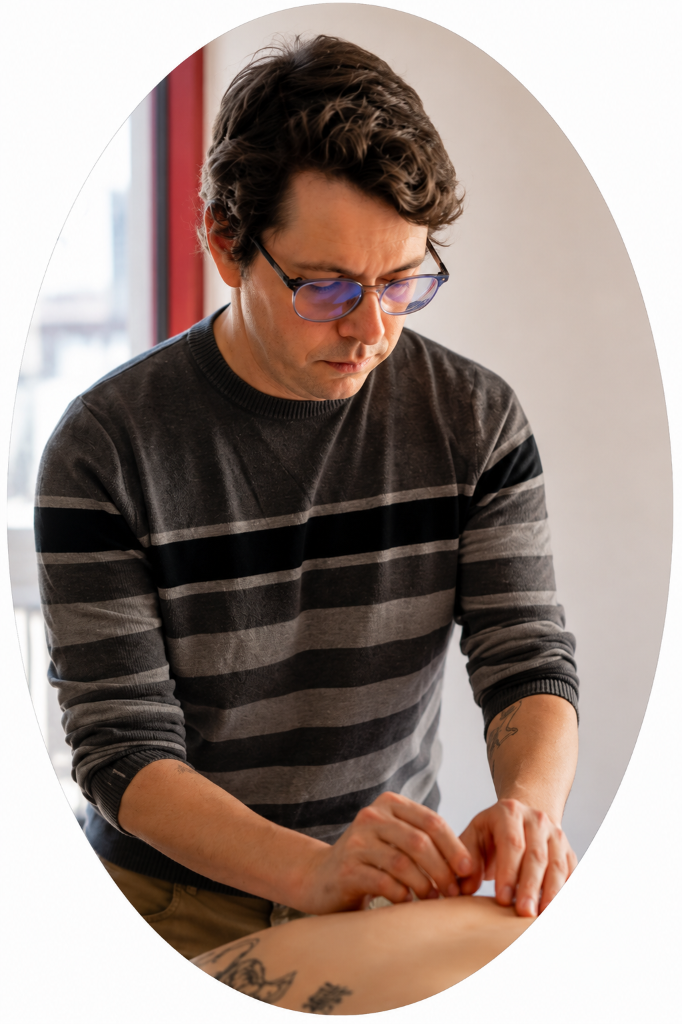
About the Author
Brian Abbott, Acupuncturist
Registered Acupuncturist · Registered Acupuncturist (R.Ac)
Brian Abbott provides highly individualized acupuncture treatments designed to address the root causes of pain, muscular dysfunction, stress, and nervous system imbalance. His calm and focused approach combines Tradition...